Owning your own company offers you flexibility, independence, and limitless chances for expansion. However, self-employed people frequently encounter particular difficulties when it comes to borrowing money. Establishing a steady income is one of the largest obstacles. A large number of independent contractors, consultants, retailers, merchants, and small business owners lack official income statements or regular pay stubs.
The good news is that self-employed people can obtain a personal loan without proving their income. These days, a lot of lenders assess borrowers based on alternative financial metrics including credit ratings, bank statements, business turnover, and digital transaction history.
In this guide, you'll learn how self-employed individuals can qualify for a personal loan, what documents may be accepted instead of income proof, and practical tips to improve approval chances.
A Personal Loan for the Self-Employed is an unsecured loan offered to business owners, freelancers, consultants, professionals, and entrepreneurs for personal or business-related expenses.
Unlike salaried applicants, self-employed borrowers are evaluated based on:
Since these loans are unsecured, lenders need confidence that the borrower can repay the amount on time.
Income proof allows lenders to assess the ability to repay.
Standard income documents include:
However, many self-employed professionals may:
This doesn't automatically make them ineligible for a loan.
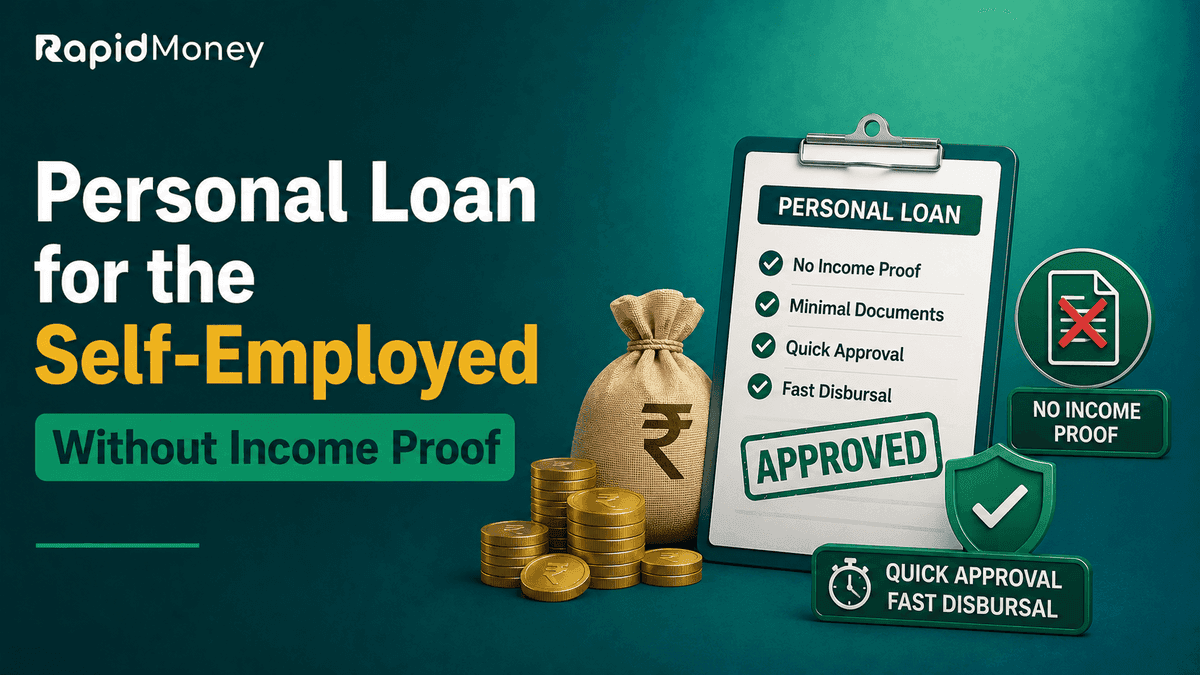
Yes, many lenders now offer a Personal Loan for the Self-Employed without income proof.
Instead of relying solely on income proof, lenders may assess:
If these signs show financial stability, it is more likely to be approved.
Lenders usually ask for the latest 6 to 12 months of bank statements.
They assess:
Strong banking behavior can significantly improve eligibility.
GST returns provide evidence of business transactions and revenue.
Lenders use them to understand:
This is especially useful for small business owners and traders.
A strong credit profile can sometimes compensate for limited income documentation.
Generally:
A higher score improves approval chances and may help secure lower interest rates.
Banks and NBFCs often approve loans more easily for existing customers.
If you have:
The lender already has financial insights that may reduce documentation requirements.
Owning valuable assets can strengthen your profile.
Examples include:
Although personal loans are unsecured, assets can enhance lender confidence.
Also Read : How to Get Personal Loan without salary slip
Before you apply, check your credit report.
Look for:
You might want to work on your score before you apply, which can raise your chances of approval.
Prepare:
These documents are available to help to make processing faster.
Different lenders have different eligibility criteria.
Compare:
Most lenders provide digital applications.
You'll typically need to:
Usually takes a few minutes.
The lender may verify:
If everything checks out, approval and disbursement can happen quickly.
Numerous lenders provide quick approval and payment.
This is useful during:
Personal loans are generally unsecured.
You don't need to pledge:
It makes it easier to borrow.
Funds can be used for various purposes.
Examples include:
Borrowers can choose repayment tenures based on affordability.
Longer tenures may reduce monthly EMI burden.
A poor score signals higher risk.
Prior to applying, work on enhancing your credit profile.
Applying to many lenders simultaneously can negatively impact your credit score.
Research carefully and apply selectively.
Irregular deposits or frequent overdrafts can raise concerns.
Maintain healthy account activity.
Even minor discrepancies can trigger rejection.
Always provide accurate details.
Financial discipline is demonstrated by a steady average balance.
Even if income verification is not required for ITR files, trust increases.
Lower debt obligations improve repayment capacity.
Better deals and simpler approvals are frequently given to current clients.
Digital payment records create a transparent financial trail.
A strong score remains one of the most powerful approval factors.
Consistent repayments improve your borrowing profile.
Think About Starting with a Lower Loan amount
It might be simpler to get approved for a smaller loan without proof of income.
Even simple financial records can strengthen your application significantly.
Yes. Some lenders accept bank statements, GST returns, and alternative financial documents instead of ITRs.
Most lenders prefer a score above 700, while 750+ offers better approval chances.
No, collateral is not needed for the majority of personal loans, which are unsecured.
Your credit profile, business stability, banking history, and lender policies all influence the amount that is authorised.
Yes. Freelancers, consultants, and independent professionals can apply if they meet lender requirements.
While some digital lenders may take a few business days, many offer approvals in a matter of hours.
Indeed. Regular bank transactions are frequently used as substitute evidence of income.
Yes. GST records help lenders verify business activity and turnover.
It is no longer as hard for self-employed people to obtain a personal loan without proof of income. In addition to traditional pay stubs, modern lenders consider credit history, bank statements, GST returns, business profitability, and general financial behaviour.
Maintain a good credit score, organise your banking records, and show steady company activity to increase your chances of approval. You can swiftly and confidently obtain the money you require by selecting the appropriate lender and getting the required substitute documents ready.
If you intend to apply, thoroughly evaluate eligibility conditions, compare lenders, and select a loan that best suits your ability to repay.