You filled out the form, uploaded your documents, and waited. Then the message came: application declined. No explanation, just a flat "no."
If you've been there, you know how frustrating it feels — especially when you genuinely need the money. The good news is that a rejection almost never happens randomly. There's usually a specific, fixable reason for personal loan rejection sitting somewhere in your financial profile, and once you know what it is, you can do something about it.
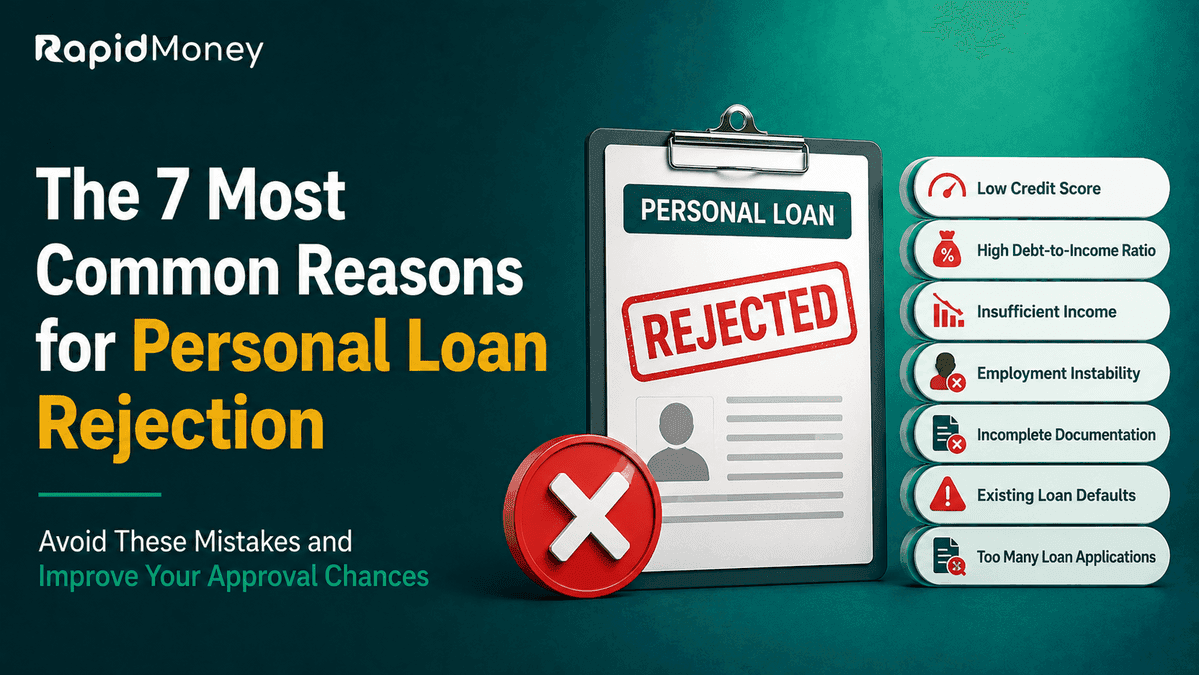
This guide breaks down the seven most common culprits, explains exactly why lenders care about each one, and gives you a clear path to a stronger application next time.
A personal loan is unsecured — there's no car, house, or gold to fall back on if you stop paying. So the lender's entire decision rests on one question: how likely is this person to repay me?
To answer that, they look at your income, your credit behavior, your existing debts, and how well your paperwork matches what you've claimed. Get even one of these wrong, and the algorithm (or the underwriter) hits pause.
Knowing this changes how you approach borrowing. Instead of applying and hoping, you can audit yourself first — the same way a lender would — and fix the weak spots before they cost you an approval.
This is, by a wide margin, the number one reason for personal loan rejection. Most banks and NBFCs want to see a score of 750 or higher before they'll even consider you a low-risk borrower.
Your score drops because of things that feel small in the moment but add up fast:
Fix it: Set up auto-pay for every EMI and credit card bill. Keep your card usage under 30% of your limit. Pull your credit report every few months and dispute any error you spot — mistakes on credit reports are more common than people realize.
That’s your Debt-to-Income (DTI) ratio, and it’s a silent dealbreaker even for folks with good credit scores.
This is how it happens in real life. Assume you earn ₹50,000 a month and you already pay ₹28,000 towards existing EMIs. That’s a 56% DTI—well above the 40–50% cap that most lenders desire. To them, you are already maxed out and a new loan is simply an additional risk.
Fix it: Pay off a small loan before applying for a new one, hold off on stacking debt, and if you can, wait for a raise or a side income to shrink that ratio naturally.
Stability matters more than the actual number on your payslip. A recent job switch, a short work history, or income that swings month to month all make underwriters nervous — even if your average earnings look fine on paper.
If you are salaried and you apply, normally you will need to show a history of consistent deposits in your bank account and a fairly established employer. There’s a somewhat different bar to cross for self-employed candidates. Lenders want to see regular business income through ITRs and bank records, not a good year followed by a poor year.
Fix it: If you can, wait a few months after switching jobs before applying. Keep your income documentation current, and if you're self-employed, make sure your ITRs reflect your actual cash flow.
It feels logical — apply everywhere, and surely one will say yes. In reality, this often backfires.
All applications will result in a hard inquiry on your credit report. A cluster of inquiries in a short period reads as financial distress to the next lender in line, and it can become its own reason for personal loan rejection even if your finances are otherwise solid.
Fix it: Check your eligibility with a lender's pre-qualification tool (which usually uses a soft check) before submitting a full application. Apply selectively, not everywhere at once.
Sometimes the rejection has nothing to do with your finances — it's a documentation slip.
Common culprits include:
Fix it: Before sending, quickly go through a short checklist - PAN, Aadhaar, last salary stubs, bank details, proof of income, address proof and a passport size photo. A five-minute examination can save weeks of delay.
Even a healthy-looking credit score can hide red flags underneath. If you've settled a loan (rather than paid it off in full), had an account written off, or missed multiple EMIs in the past, lenders will spot it — and it tends to weigh heavily on their decision.
Fix it: Pay off any outstanding bills as quickly as possible, don’t settle debts if you can avoid it by paying them off correctly and most importantly, keep consistent going forward. It takes time to fix, but it works.
Every lender sets its own rules — minimum age, minimum salary, acceptable employment types, even the city you live in. You might be perfectly creditworthy and still get declined because you don't fit one specific lender's box.
For example, one bank might require a minimum salary of ₹25,000, while another comfortably approves applicants earning ₹15,000. Neither is "wrong" — they just serve different borrower segments.
Fix it: Compare eligibility criteria across two or three lenders before applying. It takes ten extra minutes and can be the difference between an approval and a hard inquiry that goes nowhere.
Once you know which of the above applies to you, the fix usually follows a similar pattern:
A few habits trip people up more often than they realize:
None of these feel like a big deal individually. Together, they're one of the most avoidable versions of loan rejection out there.
Building a positive credit history can help you understand your creditworthiness. Read our guide on how to build credit from scratch to learn how to establish a credit profile.
Poor credit score or track record of missed payments. Lenders read this as a strong signal of repayment risk, so it's usually the first thing they check.
You can, but it's smarter to pause first. Find out why you were declined, fix that specific issue, and then reapply — reapplying blindly just adds another hard inquiry.
The rejection itself doesn't do much damage. What hurts is the hard inquiry tied to the application, especially if you've applied to several lenders in a short stretch.
Most lenders look for 750 or above, though some will still approve you with a slightly lower score if your income and repayment history are strong.
Yes. Lenders will want to see steady business income, filed ITRs, and consistent bank statements rather than a formal payslip.
It does. Some people prefer to wait a few months after a job change because a short tenure at a new position indicates instability.
7. How long should I wait before applying again?
Depends on what the reason for the denial was. One may rectify a documentation issue in a week. High DTI or bad credit score can take months of conscious repair.
A loan rejection isn't the end of the road — it's information. Whether the reason for personal loan rejection in your case was a low credit score, a high DTI, shaky income, or something as small as a document mismatch, every one of these is fixable with a bit of planning.
Get your credit report, clean up your papers and compare lenders whose criteria really do match your profile before you try again.” Do that and your next application will not appear like the one that got turned down.