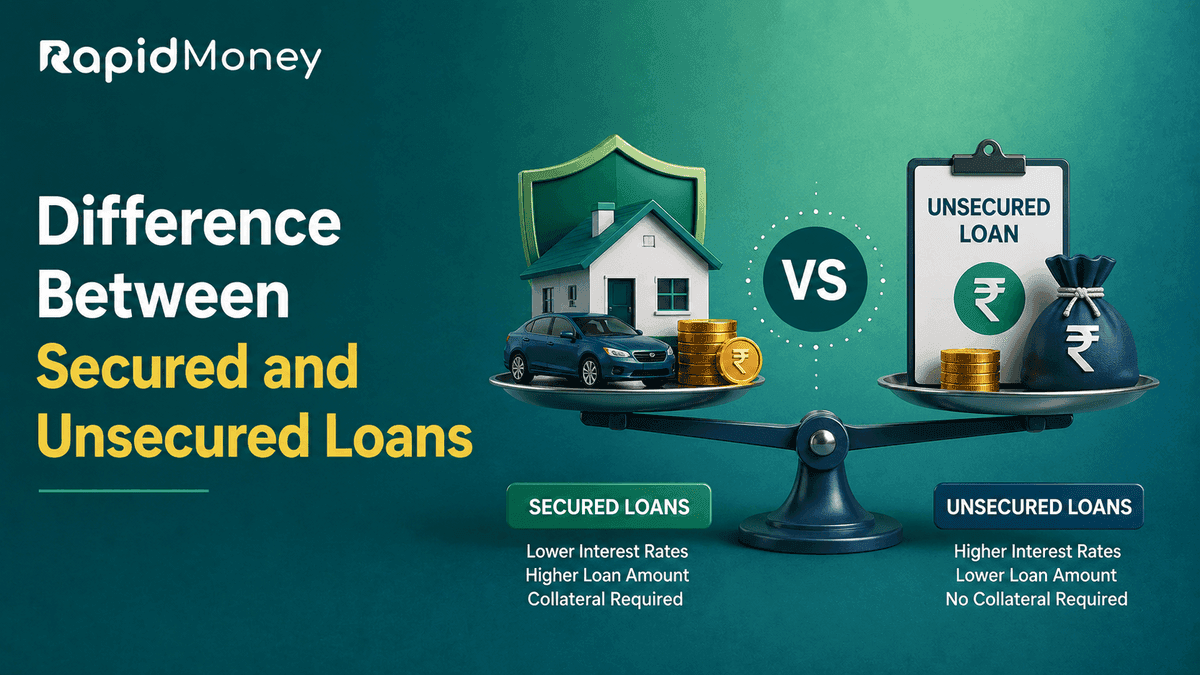
Loans are crucial financial tools for managing emergencies, achieving personal dreams, supporting companies, and large life costs. If you are intending to buy a property, restore your home, pay medical costs, fund a wedding or cover vacation expenses, choosing the right sort of loan is very crucial.
One of the most common questions borrowers ask is: What is the difference between secured and unsecured loans?
Understanding these two loan categories can help you make smarter financial decisions, avoid unnecessary risks, and choose the best loan option according to your needs.
A secured loan is a type of loan where the borrower provides an asset as collateral or security to the lender.
The lender has the legal right to seize the asset if the borrower fails to repay the loan.
In secured loans, the asset reduces the lender’s risk, which is why these loans usually offer lower interest rates.
An unsecured loan is a loan that does not require any collateral or security.
The lender approves the loan based on:
In a secured loan the borrower promises an asset to the lender.
For instance:
In a home loan the collateral is the house itself.
If the borrower defaults:
This reduces risk for lenders and helps borrowers get better interest rates.
Unsecured loans are approved based on the borrower’s financial profile.
Lenders evaluate:
Since there is no security involved, lenders charge higher interest rates to compensate for the additional risk.
This helps borrowers save money over the life of the loan.
Since collateral is provided, lenders are comfortable approving larger loan amounts.
For example:
Secured loans generally offer flexible repayment periods.
Example:
Long tenure reduces EMI burden.
Even borrowers with moderate credit scores may get approval if they provide valuable collateral.
The biggest drawback is the possibility of losing your pledged asset if repayments are missed.
Secured loans involve:
Borrowers need to submit:
Borrowers do not need to risk personal assets.
This makes unsecured loans highly convenient.
Most instant personal loans are approved quickly.
Some lenders even offer:
Basic documents are usually enough:
Unsecured loans can be used for:
Interest rates are higher due to increased lender risk.
Lenders carefully examine:
A low CIBIL score may lead to rejection.
Loan amounts are generally smaller compared to secured loans.
The answer depends on your financial needs.
A home loan helps purchase or construct a property.
Features:
Gold loans are ideal for short-term emergency funding.
Benefits:
You can mortgage residential or commercial property to obtain large funds.
Used for:
Personal loans are among the most popular unsecured loans.
Used for:
Instant loans are digitally approved loans offering quick cash access.
Best for:
Credit cards provide revolving credit for short-term spending needs.
Your CIBIL score plays a major role in unsecured loans.
A score above 750 improves:
For secured loans, lenders may still consider low scores if strong collateral is available.
Always compare multiple lenders before applying.
Some lenders charge high hidden fees.
Read:
carefully before signing.
Avoid unnecessary debt burden.
Avoiding these mistakes helps maintain financial stability.
To improve your chances of approval:
Digital lending is growing rapidly in India.
Fintech companies now offer:
Borrowers can now access loans conveniently through mobile apps and online platforms.
Before you take out a loan, you need to understand the difference between secured and unsecured loans. Either sort of loan has its advantages and disadvantages.
If you’re able to provide security and want to borrow a larger amount of money at a lower interest rate, secured loans are good. Unsecured loans are your best bet if you want to borrow easily and be approved quickly without collateralizing your possessions.
Before applying for any loans, consider carefully your financial condition, your ability to pay back a loan, the interest rates and loan terms. Responsible borrowing is vital to help you achieve your financial goals and to protect your long-term financial health.
The key difference is that secured loans are backed by collateral while unsecured loans are not.
Secured loans generally offer lower interest rates.
It may be difficult, but some lenders offer loans with higher interest rates.
A personal loan is usually an unsecured loan.
The lender may seize and sell the pledged asset to recover dues